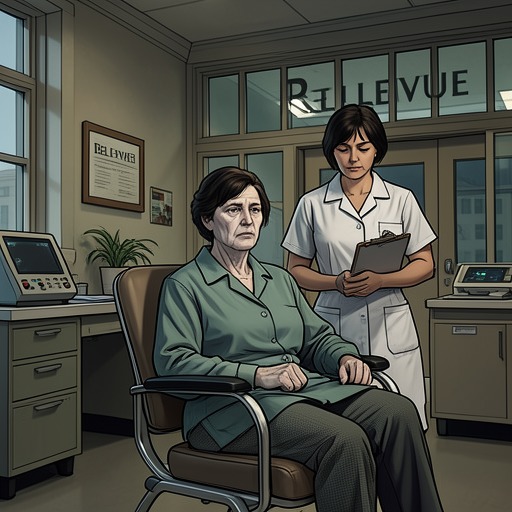
Dr. Spencer
Requiem for a DreamDr. Spencer is a young medical resident whose brief but consequential appearance turns Sara Goldfarb’s hospitalization into a conflict over what counts as illness and who has the authority to treat it. After examining Sara, he identifies a medical explanation for her disorientation and tries to transfer her out of the psychiatric ward. His careful attention to her body and medication history is set against a hospital administration that knowingly leaves her under a diagnosis he considers wrong and a treatment he believes dangerous.
Identity and First Assessment
Dr. Spencer enters the narrative as a resident working in the hospital, not as a doctor with power over its psychiatric department. His position is made clear by the opposition he encounters: Dr. Reynolds is his superior, and Dr. Harwood administers the department. The text provides little personal background for Spencer; instead, it defines him through his clinical attention and his willingness to challenge decisions made above him.
At Sara’s bedside, Spencer examines her slowly and carefully. He listens to her chest and back, asks her to raise her arms and bend her fingers, and notices both the loose flesh on her upper arms and the hollows around her eyes. When he asks whether she has recently had a heart attack, Sara says no, though her heart is beating very hard. She explains that she has lost weight because she expects to wear her red dress on television. Spencer’s gentle questioning eventually brings out the history behind that change: the pills, the doctor who supplied them, and her repeated preoccupation with Seymour, her son, and television.
That history matters because Sara’s weight loss had already been framed as success in her earlier treatment. A doctor had prescribed her a package of pills and instructions after telling her she was in good condition; at her next visit, she was praised for losing ten pounds in a week and reassured about effects such as grinding teeth and bulging eyes. Spencer’s assessment puts those symptoms and her physical decline into a different frame. He learns that she has taken diet pills and Valium and has not eaten a proper meal in many months. Rather than treating her account of the red dress as proof of psychiatric illness, he connects it to the drugs and deprivation visible in her condition.
A Medical Diagnosis Against a Psychiatric One
Sara has been admitted in a completely disoriented state. Dr. Reynolds diagnoses her as paranoid schizophrenic and recommends possible shock treatment, placing her in the psychiatric service. Spencer examines the same patient and reaches the opposite conclusion: her condition is medical, arising from stimulants and depressants, inadequate food, and the resulting physical strain. He orders that she be transferred to medical, where rest, nourishment, and time for the drugs to leave her body could, in his judgment, restore her.
The difference between the diagnoses is not presented as an abstract professional disagreement. It determines which ward Sara occupies and whether her condition is treated as a bodily crisis or as psychiatric disease. A young resident later recognizes this distinction at the bedside, treating Sara patiently and reassuringly as she speaks about her life. But Spencer’s earlier effort to put that understanding into practice has already been reversed: Dr. Reynolds countermanded his transfer orders and issued a standing instruction that Spencer’s orders be ignored.
The Confrontation with Hospital Authority
Spencer takes the reversal to Dr. Harwood, arriving with his hands clenched in his pockets and his anger held under tight control. Harwood initially treats the matter as a personal feud with Dr. Reynolds. Spencer insists that the issue is patient care, not rivalry. He explains the drugs and lack of food behind Sara’s condition and says that proper nourishment, rest, and clearing the stimulants and depressants from her system should allow her to recover.
His argument draws on more than a single examination. Spencer says that during the preceding eight months he has taken six of Dr. Reynolds’ patients and treated them medically for the same symptoms and causes; all recovered in less than a month without shock treatment or psychotropic drugs. He presents those cases as experience supporting his judgment, but Harwood refuses to treat that experience as a reason to intervene. He emphasizes Reynolds’s seniority and specialist standing, and argues that Spencer is not in a position to judge his superior’s competence.
Spencer presses the ethical consequence of that deference. He argues that Sara is a medical patient, not a psychiatric one, and challenges Harwood for approving treatment without even reading her chart. Harwood acknowledges that he did not need to see it. He dismisses Spencer’s concern that shock treatments are unnecessary, reducing the potential harm to a few treatments and a few months of Sara’s life. Spencer, by contrast, insists that the patient’s right to proper care cannot be subordinated to rank or departmental convenience.
Defeat and Narrative Significance
Harwood makes his own priority explicit: his responsibility, he says, is to keep a large department functioning smoothly, not to focus on one patient. He treats Spencer’s challenge as a threat to staff order and offers resignation as the alternative to accepting the hospital’s authority. His closing appeal to harmony makes the imbalance plain. Spencer has a clinical case, examples of similar recoveries, and a direct concern for Sara, but he cannot compel the department to act on them.
The confrontation ends without Spencer winning the transfer. Harwood’s decision stands, and Spencer leaves after being reminded that he is powerless over Dr. Reynolds’s actions. The scene gives his protest moral force without granting it institutional effect: the reader sees a doctor recognize a preventable medical crisis, then watch administrative hierarchy preserve the treatment he considers harmful. Dr. Spencer’s role is therefore not that of a rescuer who can change Sara’s course, but of a witness who names the error and exposes the system’s willingness to accept risk to one patient for the sake of order.